|
Dan Gurney Chases his Concept of
the Ideal Motorcycle at his Santa Ana Shop.
Dan Gurney's always done
things his own way, and at age 68 he's not about to change. Not even if he
breaks a few bones in the process.
Gurney is the legendary Santa Ana gearhead who co-founded All American
Racers with Carroll Shelby in 1965. Today he is the sole proprietor of AAR,
and his shops stretch more than a block in south Santa Ana.
If you don't follow racing you may never have heard of Gurney, a big,
good-looking blond guy who is a hero to most every Southern California
hot-rodder older than 25. In the 60's, Gurney was famous for beating the
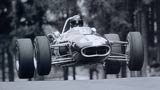
biggest names in international racing with a Formula One car - the Eagle -
designed and built in his own Santa Ana facility. In the 80's All American
Racers startled its fans by signing a long-term contract with Japanese
maker Toyota. And in the 90's he is again flouting conventional wisdom by
forsaking the ubiquitous Reynard chassis and chasing victory in the Indy
Car series with an Eagle chassis designed by his own team and powered by
an 800 horsepower V8 Toyota.
But this story's not about Champ Car racing. It's about the two-wheeled,
real world kind of racing that takes place every Sunday in Orange County,
when hundreds of motorcycle riders blast up the winding Ortega Highway.
"I've been a fan of motorcycles for a long time" Gurney says.
"I've enjoyed some bikes more than others... and you don't ever know
exactly why". One thing he didn't like was the way bikes
traditionally handle - lifting the front wheel under hard acceleration,
lifting the back under hard braking. Dan wanted something with a lower
center of gravity, a bike on which you could crank the throttle or slam
the brakes without getting thrown off. In other words, a bike that handled
more like a race car.
His first attempt was a Honda XL350 that he dismantled and stretched so
the seat could be lowered to just above the chain. The rider sits with his
feet forward. That configuration makes the bike hug the ground and explode
off the line like a dragster. It is not limited by "wheelies" it
just goes.
Jerry Whitfill, chief machinist at AAR said the long, low, mean-looking
thing resembled an alligator - and the name stuck. Alligator I was powered
by a single-cylinder engine, which makes for a narrow profile (that's
good) and lots of low-end torque (ditto). But single-cylinders vibrate
something terrible. They don't make as much high-end horsepower as modern
four - cylinders. And they're darn hard to start. Gurney recalls an old
single-cylinder BSA Victor that backfired when he cranked it, kicking the
starter peg upwards, tearing off his sneaker and nearly breaking his
ankle. To a tough guy like Gurney, that's impressive. He likes one-cylinders.
Since building that first Alligator ten years ago, Gurney has spent
hundreds of thousands of dollars trying to improve on the concept. That's
an amount that most men - even most racers - would consider folly. Each
new alteration is tested on Ortega, not just by Dan and his sons, but by
famous racers like Eddie Lawson, Mike Smith and Eric Buell. "They are
wild-looking contraptions", says Dave O'Connell, a British bike
enthusiast who rides Ortega. "Every time Gurney shows up on one there
is always a crowd around him".
One of the newest versions, known as Alligator III, was damaged just after
Christmas when Gurney slowed up for some flashing lights and an AAR
mechanic riding "hell-bent for election" hit him from behind,
knocking Gurney off the bike, cracking his ankles and breaking his wrist.
Dan ordered the bike repaired - and kept the mechanic on staff. "He's
relentless. Tenacious", says son Alex. "Almost to an
extreme".
Currently on the fabrication bench at AAR are two Alligator IV's, the
closest thing yet to the production motorcycle Dan hopes to sell some day.
With a chrome moly-frame, Brembo racing brakes, self-learning fuel
injection and carbon-fiber bodywork, the newest Alligators really bite.
The target is 80 horsepower, a 300-pound total weight and 150 mph - from
an engine AAR will build from scratch. Dan hopes to be ready for street
customers within three years, although he says the costs are so high right
now that he'd have to sell the bikes for $400,000. Son Justin says a
realistic target price is $10,000.
David Edwards, a 15-year writer for Newport Beach's Cycle World, says the
Alligator is "an iconoclastic project, way different than anything
else on the market right now". But Edwards rode the Alligator on
Ortega and he says "I've got to tell you, I was pleasantly surprised.
It's a combination of a motorcycle and a little race kart. Your butt is
skimming right over the ground. It really does give a feeling of
intensified speed".
Most industry observers say if there was a market for this type of
motorcycle, the industry heavyweights would already be there. Gurney hopes
he has carved out a niche small enough, and can build a motorcycle good
enough, to own the category.
"There are people who know a lot more than I about this business that
tell me I'm barking up the wrong tree", Dan smirks, "But this is
the tree I want to bark up".
"He
likes one-cylinders."
|