|
The Gurney Boys and Their Naughty
`Gator He’s
legendary for his Eagle race cars.
So why is Dan the Man
reinventing... The motorcycle?
By PETE LYONS
From the May 20,
2002 issue of AutoWeek
|
His office walls are festooned with
mementos of race cars and races and racing friends, but one
picture of a street-going motorcycle tells you a lot about Dan
Gurney the man. Snapped in the early ’70s, it captures him
blasting along on a CB750 Honda, then the King Kong of
Superbikes. In a baby sling on Gurney’s back is his
six-month-old son Justin, little fists gripping dad’s
shoulders. Both boys’ hair is blowing free in the wind, and
identical grins split their faces.
Think whatever PC thoughts you will about it, you see
the real Dan Gurney on that bike. What’s more, “Justino”
survived the ride to become not only a keen rider on his own,
but stylist and project manager for the Gurney Alligator—a
hand-built, high-performance street bike produced by Gurney
and his family in the same shops, and by some of the same
hands, that once built F1- and Indy-winning Gurney Eagles.
|

Dan Gurney aboard the Alligator.
|
Thus one April evening Justin, now 30 (and this time
wearing a helmet), burst out of a giant plastic foam
“Alligator Egg” aboard the 001 bike during a hatching ceremony
at the Petersen Museum in Los Angeles. Gurney, who recently
turned 71 but doesn’t behave like it, assisted the birth
wearing surgeon’s garb along with that famous grin. For once,
product outshone presentation. Gurney’s ’Gator is not just
another motorcycle. Startling in both appearance and
specification, it features a radically low solo seating
position, a single hopped-up Honda cylinder and a price tag of
$35,000.
Idiosyncratic? Sure. Dan Gurney did not become famous
for his orthodoxy. The American was never content to be one of
the finest racing drivers in the world, often mentioned in the
same breath with the great Jimmy Clark and named to F1 teams
by the likes of Ferrari, Porsche and Brabham. Gurney won four
Grands Prix, and placed as high as third in the world
championship (1961) with established factories. Yet he
stepped off a seemingly assured career ladder to make a marque
of his own.
"One
of the first books I ever read was called The Speedwell
Boys On Motorcycles.
My infatuation with racing cars and motorcycles occurred
amost in concert."

Justino and Dan in the AAR shops,
discussing the finishing touches
on Alligator 001.
|
In 1964 Gurney
and then-partner Carroll Shelby founded All American Racers in
Santa Ana, California, to build Eagle open-wheelers for FIA,
USAC and SCCA racing. Eagles became a major force in Indy
competition, with three victories at the Speed-way and many
more elsewhere. AAR also built contenders in F5000, Can-Am and
Trans-Am. Later, Toyota-Eagles dominated the endgame of the
old IMSA GTP series. That engine manufacturer then chose AAR
to carry it into CART, though results were disappointing to
both parties.
Gurney himself continued winning races through his last
year in the cockpit, 1970. But probably his personal highlight
came on the 18th of June, 1967—one magic week after co-driving
a Ford to first at Le Mans—when he scored his fourth GP
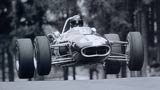
victory with his very own Eagle on Belgium’s fearsome
Spa-Francorchamps circuit.
|
Thirty-five years later, that remains a unique American
accomplishment. It’s being deliberately recalled by the dark
metallic blue and pearl color scheme of Gurney’s Alligators,
same as his F1 Eagle, and by the 36 limited-edition “Grand
Prix” ’Gators he’s planning to turn out initially.
Why 36? That’s the number his car wore at Spa. Okay,
but why a motorcycle? Why such a weird one? And why
“Alligator”? Again, it’s the genuine Gurney coming out. Behind
the movie-star face and easy amiability lurks a ferocious
heart and stubbornly independent mind. Though infamously
unable to leave well enough alone, he stands unrepentant.
“Don’t you want to win?” he’ll snap impatiently.
Dare to suggest that a man his age, of his
accomplishments, his stature in legend, could decently fade
into retirement, and you get a flash of anger from those
raptor eyes. “You mean: You old fogy, why do you keep
pushing...?” The steely retort actually is answer enough; the
man simply is made that way. But he does have a specific
rationale for what he’s doing.
Eagle
Over Spa
 |
If
you coddled kids of today want to know why Big Dan
Gurney is such a hero to us old-timers, one clue is what
he did one June day 35 years ago. He won a European
Grand Prix in his own F1 car-one he'd helped design and
produce in his own factory in California. Only once
before had a like feat been accomplished, and in the
1921 French GP Jimmy Murphy wasn't the owner/ builder of
"his" American-made Duesenberg. Nor has any American car
won a third GP. Not even Gurney's.
Way back in 1967, all bright things seemed
possible. Americans loved road racing. Phil Hill had won
the world championship, and now Dan Gurney seemed a good
bet to follow him. His new Eagle was world-class, quick
and aesthetically gorgeous too, a shapely missile of
titanium and magnesium packing a British-made Weslake
V12 thought to be the most powerful in F1.
Car and driver together made a promising
combination for the Belgian GP at Spa-Francor-champs in
the Ardennes forest, an 8.75-mile natural road circuit
of the classic style: narrow, hilly, frighteningly fast
and desperately dangerous. Gurney relished the
challenge. He qualified second for the three-wide front
row, between the Lotus-Fords of world champions Jimmy
Clark and Graham Hill. Behind them were the likes of
Jochen Rindt, Chris Amon and Jackie Stewart, and such
machines as Cooper-Maseratis, Ferraris, BRMs and
Brabham-Repcos.
Gurney messed up his start, losing seven
positions before the first corner, and spent the first
stage of the 245-mile race driving catch-up. He was
closing on second-place Stewart when Clark dropped out
of the lead with a bad plug. But at the same point
Gurney made a quick stop to report low fuel pressure.
When he dashed out again, Stewart's advantage with the
16-cylinder BRM was 16 seconds.
Gurney in a hurry was one of motor racing
history's great sights. Tall in the cockpit, face a
frozen mask of concentration but fists a blur on the
wheel, he directed the car with an uncanny blend of
fluid delicacy and utter determination. Swooping through
woods and farmland, touching 196 mph in places, the
Anglo-American Eagle once again caught and this time
passed the all-British BRM. The effort earned Gurney the
lap record at nearly 149 mph. His race average was
145.74- the fastest ever run in Europe.
"As I look back on it I'm more amazed that we
could do that with the resources we had, or didn't
have," Gurney grins today. "It was enormously gratifying
for a professional racing driver that dreams of such
things... Of course, you have targets that include doing
it more than once!
"In view of the fact that it hasn't been done
since, and that we did it, even though it was only one
it was quite a thing. I mean, you talk about puttin' the
mark up on the tree as far as you can reach, it's a
pretty good one!"
|
|
It starts with the
loss of his engine sponsor, which took AAR out of racing. That
was a bitter blow at the time, but although Gurney has been
mentoring son Alex’s career, he has no interest in returning
his company to the fray.
“I feel as though we’ve escaped,” he recently wrote to
friend John Surtees, “and I do not want back into an arena
which has been taken over by bureaucrats and rich
corporations. They have come up with rules that stop
creativity and progress, so they don’t have surprises.”
But Gurney has loyal, longtime employees to think of,
including three of his six children—older sons Danny and Jimmy
also work at AAR with Justin. So does wife Evi. The present
staff numbers 35. Many are busy on a project for the U.S.
Navy, in addition to the Alligator, and the company still has
facilities and expertise to offer the racing and/or
restoration industries.
Besides those factors, Gurney has a personal reason:
the challenge of reaching a long-visualized goal. “It’s a bit
like a parting shot,” he admits. He daydreams about building a
sports car someday, but right now he’s intent on this sport
bike project. He loves motorcycles, and the Alligator is very
much his motorcycle. He thought it up. He helped design and
build and test five prototypes. He persisted with his idea for
26 years, he paid for it and now, dammit, he means finally to
manufacture and sell it.
Doing so climaxes a fascination for bikes incurred in
boyhood. “One of the first books I ever read was called The
Speedwell Boys on Motorcycles,” Gurney remembers, smiling. “My
infatuation with racing cars and motorcycles occurred almost
in concert.” As a teen he had both, and freely modified them.
“Those were great days, when you were allowed to do that.”
One modification he made on a dirt bike led directly to
the Alligator. Tall, Gurney often felt unstable on steep
hills, as though his weight were about to pitch the
short-coupled machine over its downhill wheel. So he tried
taking the seat off. “I’m sitting a little lower, and it felt
better. I thought, ‘How about if we went as far as we can...’”
The result was a 1976 experiment now dubbed The
Grandfather. Based on a 350 Honda dual-purpose model, its
wheelbase was lengthened so the rider could sit down low
behind the engine. “We liked it a lot,” Gurney says, “but
pretty soon it was not powerful enough and too heavy, and it
got more laughs than it should have...”
Disregarding the jibes, Gurney, his sons and his
friends continued experimenting with his “long-low motorcycle”
idea, building and evaluating a series of ever more refined
prototypes. Along the way they abandoned the original off-road
concept and honed the bike for highway sport riding. For years
it was no more than a weekend hobby, but dropping out of CART
forced Gurney’s business into survival mode— his words. It was
time to find out if the Alligator had commercial potential.
The name? It was suggested by AAR head machinist Jerry
Whitfill, and Gurney immediately agreed it was perfect for a
long, low-slung, “naughty” machine that “has a good bark to
it.”
Sixth in the line of designs, the A-6 production model
has a graceful, finished appearance despite the unusual seat.
The wheelbase looks long, but at 60 inches it’s only a couple
of inches longer than a conventional sport bike. The solo
rider sits just above hub level, legs extending forward almost
as in a car. Though the position recalls that of a recumbent
bicycle, the spine has to be more erect so the hands can reach
the bars. What appears to be a traditional gas tank is
actually an intake plenum for the fuel-injected engine; fuel
is in a 3.3-gallon composite cell just ahead of and beneath
the seat, protected by framework.
Gurney takes credit for laying out the multi-tube
chassis backbone, based on knowledge absorbed during his
friendship with Colin Chapman. AAR veterans including the
legendary Phil Remington fabricate that frame, the extruded
aluminum rear suspension swing arm and most other parts,
though the front forks and brake package come straight from
Honda’s ultra-fast 954. Front and rear lights are from another
Honda, but the carbon fiber bodywork is laid up and baked in a
corner of AAR that used to make Eagle GTP and Champ Cars.
The air-cooled one-cylinder starts life as a new Honda
650 with electric-start made for an enduro bike. Subcontractor
Drino Miller punches it out to as much as 710 cc, adds hotter
cams and replaces the stock carb with fuel-injection. Output
is better than 75 horsepower. Competitive four-cylinder bikes
offer more power, but weigh more than the Alligator’s 320
pounds and their riders catch more wind. Without admitting
he’s tried it, Gurney reckons his bike should do 140 mph. He’s
confident it’ll go 0 to 60 mph quicker than anything on the
road. (“It explodes off the line!”) He also claims exceptional
braking performance and reassuring handling, both thanks to
the low center of gravity. He is careful to emphasize the
importance of never letting one’s forward-jutting foot snag on
the road or a curb, to prevent potential injury.
Gurney admits he’s probing a tiny niche market.
Customers? “Someone who wants to buy the Ferrari of Singles...
that loves ‘More Smiles per Mile’... has a naughty element in
his character, and one that can afford to pay 35,000 bucks for
a bike.” The Alligator is not intended for racing, Gurney
emphasizes, but he tried to put a lot of his racing experience
into it. “If you have been a race driver, you were kind of on
top of the pyramid and you got to sample a whole bunch of
really cutting-edge machinery that nobody else did.
“So you say to yourself, wouldn’t it be nice to make
something [cutting-edge] that I could still ride, and also my
friends or customers could ride. Is there something I could
bring to the table that maybe otherwise wouldn’t get there,
because of my background and all the efforts we made to
understand what makes one race car good and another one not
quite so good.” Does he mean to reinvent the wheel?
Of course not. Everybody knows that’s the definition of
futility. But reinventing the two-wheeler? Dan Gurney, born
maverick and relentless competitor, is happy to gamble that’s
another story.
|